
The Blog

Is the Poon Hill Trek Worth It? An Honest Take From a Nepali Trekker
Guest post written by Bhishu Acharya.
Let me tell you about the moment I stood at Poon Hill, one of the most famous sunrise viewpoints in Nepal, and saw absolutely nothing!
Not the Annapurna range. Not Dhaulagiri. Not Machhapuchhre’s distinctive fishtail shape that you see on every Nepal travel poster. Just a flat wall of cloud, grey in every direction, with about forty other trekkers standing around in the cold doing exactly what I was doing: waiting for something that was not going to happen.
We had hiked for two days to get there. In April, which is supposed to be one of the good months, right? Sadly, I learned that considering weather window is what you should focus more on rather than relying on ‘best season’.
So, is the Poon Hill Trek worth it? My honest answer is still yes!
But I want to tell you a few things before you head to Pokhara, because the version of this trek that most guides describe and the version that actually exists are not quite the same thing.
What's in this post:
What Is Poon Hill, and Why Does Everyone Go There?
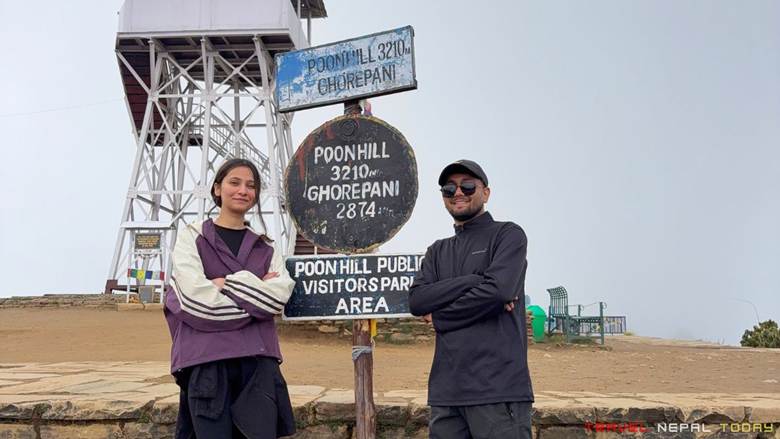
Poon Hill sits at 3,210 meters in the Myagdi District of Nepal, inside the Annapurna Conservation Area.
It is the highest point of the Ghorepani Poon Hill Trek, which is consistently rated as one of the best short treks in the country for a straightforward reason: you get proper Himalayan mountain views without needing two weeks or exceptional fitness to reach them.
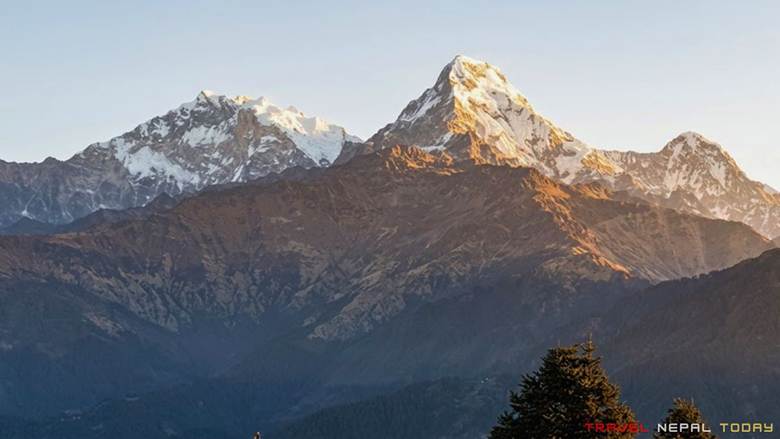
From the viewpoint tower at the top, on a clear morning, you can see Dhaulagiri I (8,167 m), Annapurna I (8,091 m), Annapurna South (7,219 m), Machhapuchhre (6,993 m), Lamjung Himal (6,983 m), Hiunchuli (6,441 m), and Nilgiri peaks.
That is a lot of significant mountains visible from one spot at a walkable elevation, which is exactly why this trail has been drawing trekkers for decades.
The standard itinerary starts from Nayapul or even Banthanti (with a jeep ride from Pokhara), climbs through rhododendron forest to Ghorepani village at 2,874 meters, then hikes up to Poon Hill for the pre-dawn sunrise, and returns.
Just a 2-day trek from Pokhara. Simple, well-marked, and genuinely accessible for most fitness levels. But here is what I want you to know before you do exactly that.
The Weather Problem Nobody Properly Warns You About!
The standard advice is to go in spring (March to May) or autumn (October to November). Both are accurate as general windows.
But Nepal’s weather has become significantly less predictable over the last few years. And the Poon Hill area specifically is affected in a way that can make any month difficult to predict for views, even though they remain in the “recommended” window.
My mid-April visit was a clear example. Rhododendrons were still partially showing on the trail, which was a genuine highlight.
But the mountains? Not a single one! Two full days of cloud cover, which is not rare for that time of year, is actually common in mid to late spring.
The months with the most reliable mountain views are October through December.
October in particular tends to give you the clearest skies of the year, the kind where you stand at Poon Hill and can pick out individual ridgelines on the distant peaks. That is the window I would push most international trekkers toward, especially if the mountain view is the main reason you are coming!
The practical thing to do before any trek in Nepal is to check weather forecasts specifically for the Ghorepani region (not just “Nepal weather“) a few days before departure. This one step saves more disappointment than any amount of seasonal planning.
Why You Should Add Kokhe Danda and Mohare Danda On Your Itinerary
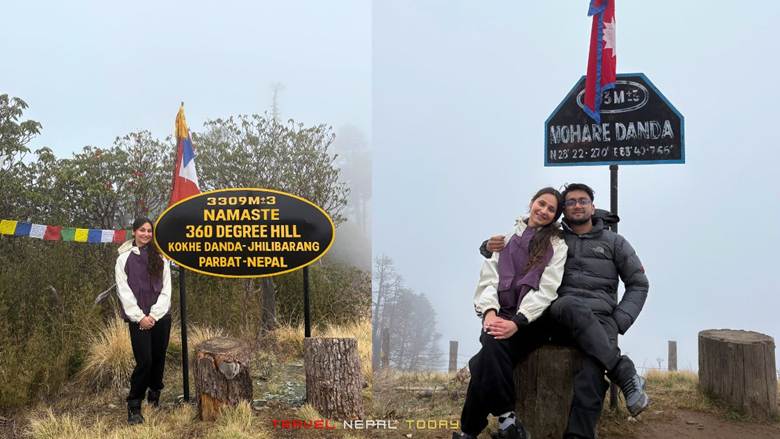
Here is the route I have to tell you about (and you’ll rarely find on the web).
Most trekkers do Poon Hill and go home. But if you have even one extra day, there is a significantly less crowded trail that climbs past Poon Hill to Mohare Danda (3,313 m) and Kokhe Danda (3,309 m), two viewpoints that are almost unknown to international trekkers.
And here’s the secret: they offer even better panoramic views than Poon Hill itself!
Kokhe Danda is the highest point in the whole of Parbat District. The 360-Degree Viewpoint there is something I would go back for specifically!
From that spot, on a clear day, you can see Machhapuchhre directly in front of you, the full Annapurna massif to the left, Dhaulagiri to the far west, and the Langtang range in the far distance.
You can trek either way: first hike to Mohare Danda via Kokhe Danda, then reach Poon Hill and return via Ghorepani, or just the opposite.
The trail from Banthanti takes you through Taprang, Doya Ple, Tutan, and Danfe Hill before reaching Kokhe Danda, and then just another 30 minutes to Mohare Danda.
The return route then passes through Poon Hill and Ghorepani before coming back down, which means you complete a full circuit rather than simply retracing your steps.
And on that full circuit, you walk through rhododendron forest in a way that the straight Ghorepani route does not quite give you. The trail from Kokhe to Mohare to Poon Hill in spring is exactly what Nepal trekking photographs look like in magazines!
For full details on both routes to reach Poon Hill, the guides on Travel Nepal Today cover the Mohare Danda Trek and Kokhe Danda Trek in depth.
Getting There: Transport From Pokhara Explained Properly
This is the section most guides get confusingly vague about, so let me be direct.
You start from a place called Hari Chowk in Pokhara (or from Baglung Bus Park). That is the departure point to get the shared jeep and the public bus that serve this trail:
- By shared jeep to Banthanti: A jeep takes about 3 hours to reach Banthanti (2,160 m), which is the practical starting point for the trek. If you are in a group of six or more, you can reserve a private jeep. If you are traveling solo or in a smaller group, you can find other trekkers going the same direction and split the cost. The road from Nayapul onward is unpaved and fairly bumpy, but manageable.
- By public bus to Ulleri: There is one bus per day, departing Hari Chowk early in the morning. The bus only goes as far as Ulleri, which means you then hike an additional 1.5 hours uphill to reach Banthanti before your actual trek begins. It is cheaper, but on a short 2-day trip, that extra 1.5 hours at the start matters.
But if you prefer hiking from Nayapul (the OG trailhead), you can easily get on a public bus heading to Baglung, or even find cabs from Pokhara to get here.
And in case you’re booking your trek with a trekking agency, they’ll handle the transportation for you. So, no worries!
What Each Day Actually Feels Like in Ghorepani-Poon Hill Trek
Now, let’s get into how your two days of the Ghorepani-Poon Hill itinerary look (and also the 3-day version on the latter section):
Day 1: Nayapul or Banthanti to Ghorepani
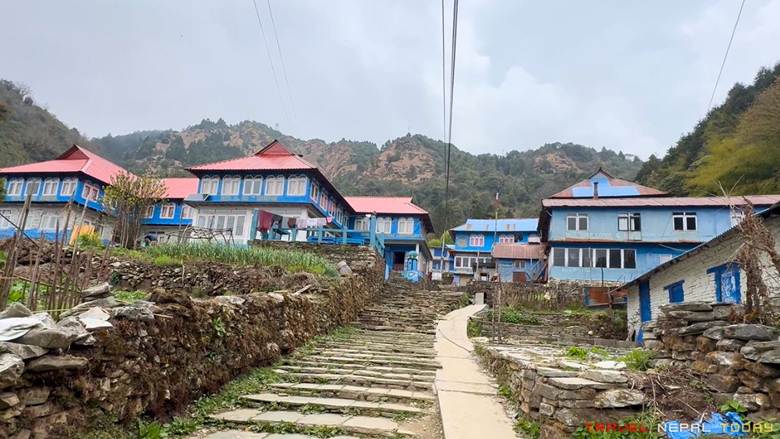
After you’re arrived in Banthanti or Ghorepani, you’ll star your hike immediately.
The trail from Banthanti to Ghorepani (2,874 m) is stone-paved and well-maintained. You will not get lost, and you will not encounter any technical sections.
It is an uphill hike, genuinely uphill the whole way, but the incline is steady rather than brutal and most trekkers cover it in 4 to 5 hours at a normal pace.
The villages you pass through are predominantly Gurung and Magar communities. These are the indigenous hill communities of the Annapurna region, and the stone houses with slate roofs, the terraced farmland, and the small monasteries and chortens (Buddhist shrines) along the trail give the walk a cultural texture that you would not get from just looking at photos.
Take the clockwise direction around any mani walls or chortens you pass. It is respectful and the locals notice when you do it!
Ghorepani itself is a proper village with multiple lodges and teahouses. Accommodation is in twin-sharing rooms, meals are included in most packages, and the dining rooms with their woodfire stoves are genuinely warming after a long uphill day.
And if you are there in spring, the rhododendron coverage around Ghorepani is as good as it gets anywhere in Nepal.

Day 2: Poon Hill Sunrise and Descent

The alarm goes off at 4:30 AM. You hike 1.5 km uphill to Poon Hill in the dark, which takes about an hour. There is a small entry fee for the viewpoint (your guide handles this). The viewpoint tower at the top gives you an elevated angle above the treeline.
Whether you see mountains depends entirely on the weather that morning. This is the honest reality of Poon Hill that no itinerary can change.
On a clear morning, the golden light hitting the Annapurna range from the east is exactly as good as you have seen in photographs. On a cloudy morning, you stand in the cold with everyone else and wait until you accept it is not going to clear.
After returning to Ghorepani for breakfast, the descent back to Banthanti takes 2 to 3 hours. Your knees will feel it on the way down, especially on the steeper switchbacks.
Trekking poles make a genuine difference on this section.
In our case, my partner’s ankle gave out on the descent on our trip, and we ended up spending an unplanned night in Tikhedhunga as a result. Not a disaster, but not what we had planned either.
The 3-Day Version: Kokhe-Mohare-PoonHill Circuit
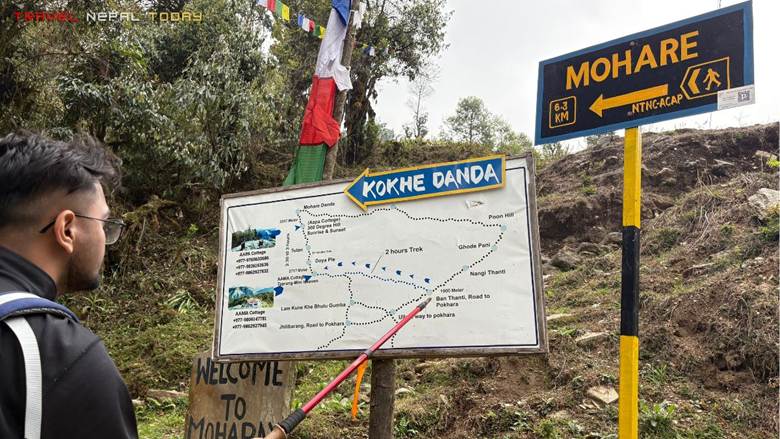
If you have one more day, this is the itinerary I would actually recommend over the standard 2-day version.
You start from Banthanti, take the left trail toward Kokhe Danda instead of the right toward Ghorepani, complete the full circuit, and return having seen considerably more.
Here is how the days break down:
- Day 1 (Banthanti to Mohare Danda via Kokhe Danda): Jeep from Hari Chowk to Banthanti (3 hours), then take the left fork toward Kokhe Danda. You pass through Taprang (2,717 m) for a snack stop, continue through Doya Ple, Tutan, and Danfe Hill before reaching Kokhe Danda (3,309 m). Spend time at the 360-degree viewpoint just 5 minutes from the cottage. Then push another 30 minutes to Mohare Danda (3,313 m) for the night. Total hiking is 5 to 6 hours. My tip is not to miss the sunset from Kokhe Danda!
- Day 2 (Mohare Danda to Banthanti via Poon Hill and Ghorepani): Wake early for sunrise from Mohare Danda, then begin the descent through Poon Hill (3,210 m), down to Ghorepani for breakfast, and continue through Nangithanti back to Banthanti. This completes the full circuit. Total hiking: 6 to 7 hours. You can take it further and head to Tikhedhunga or Nayapul if you’re opt for it.
- Day 3 (Return to Pokhara): From Banthanti/Nayapul, either arrange a shared jeep back to Pokhara (about 3 hours) or hike down to Ulleri to catch the 2 PM public bus. If you are in a smaller group, sorting the jeep the night before by coordinating with other trekkers at the teahouse saves a lot of time in the morning.
Permits and Costs: What International Trekkers Need to Know
One permit is enough for this trek, and you can get it from the NTNC portal. It is a pretty straightforward process and all you have to do is fill up the form online. Also, you may get it from Pokhara or Kathmandu’s ACAP Entry Permit Counter.
ACAP Permit (Annapurna Conservation Area Permit) is basically the main entry permit for the conservation area. The cost is NPR 3,000 for foreign nationals (approximately USD 25) and NPR 1,000 for SAARC nationals.
Note that your permits are checked at a place called Birethanti, the same point where you show the permits for reaching Ghandruk or the famous Annapurna Base Camp trek.
Final Verdict: Is the Poon Hill Trek Worth It?
It is worth being honest here, since most travel content about this trek skips this part entirely.
When Poon Hill Is NOT Worth the Trip
Poon Hill is not worth the effort if:
- You are visiting purely for the mountain views and refuse to accept that weather might not cooperate, with no plan for how to handle that.
- You are doing the 2-day version in late April or May and have not checked forecasts in advance.
- You have knee problems and have not brought trekking poles (the descent is long and your knees will raise the issue themselves).
- You expect the infrastructure to match anything you have seen in European hiking destinations (it does not, and that is fine, but set the expectation correctly).
When Poon Hill Is Absolutely Worth It
- You go in October or November with clear forecasts and get the sunrise you came for.
- You take the extended route via Kokhe Danda and Mohare Danda, which gives you the circuit experience rather than an out-and-back.
- You come ready to accept that the rhododendron forest section, the Gurung village culture, and the overall experience of being on a well-made trail in the Himalayan mid-hills has value even when the mountains are hiding behind clouds.
- You are doing your first in Nepal and want something achievable that still gives you a real sense of what trekking here actually feels like.
Because here is the thing about Poon Hill, even when it did not give me the views I came for, it gave me something else:
- Two days of walking through a rhododendron forest, blooming different color flowers (which is also the national flower of Nepal, by the way)!
- Gurung villages that have their own rhythm entirely separate from anything happening in Pokhara or Kathmandu.
- A stone trail that has been walked by trekkers for 40+ years, but still manages to feel like it belongs to the mountain rather than to tourism.
In fact, even I know I will do the Kokhe Danda circuit version and give myself one more chance at that clear morning. Keep updated with me on Travel Nepal Today, as I’ll be posting more on Nepal treks there.
So, yes, the Ghorepani-Poon Hill Trek is absolutely worth it. Go with honest expectations, check the weather properly before you leave, and if you have a spare day, do not stop at Poon Hill. Reach Mohare Danda and Kokhe Danda too!
Nepal does not guarantee you the view, but it gives you something more than the trip anyway. It’s more about the culture, nature, and the digital detox you deserve!
Author’s Bio
Bhishu Acharya is a travel writer from Nepal who is on a mission to promote his country and explore every corner of it. He shares his stories on Travel Nepal Today and also leads multiple travel agency content teams.

1 Comment on Is the Poon Hill Trek Worth It? An Honest Take From a Nepali Trekker
Be the first to comment