
The Blog

What Visiting a Txakoli Winery Taught Me About the Basque Country
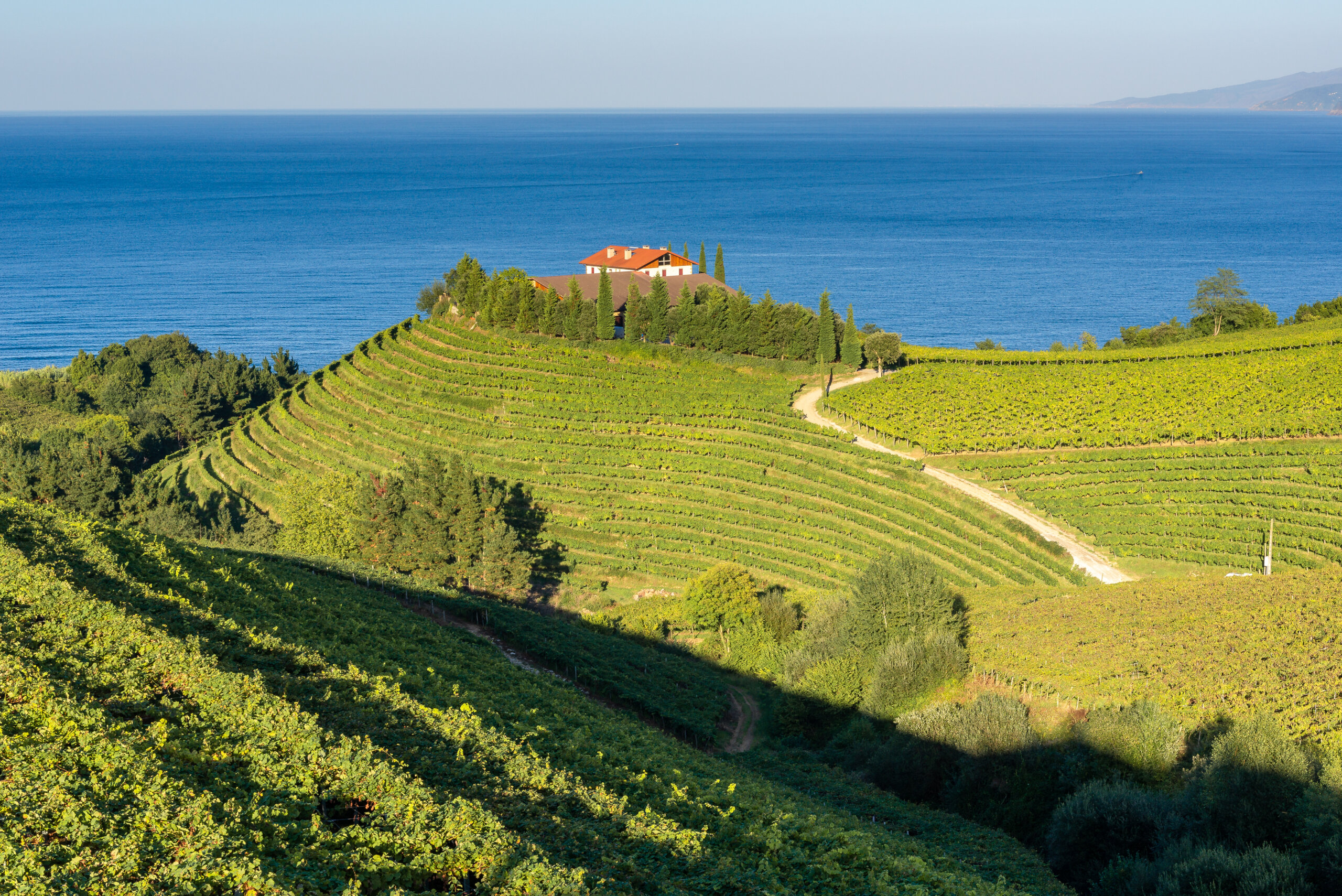
When most people plan a trip to the Basque Country, a Txakoli winery tour probably isn’t at the top of their itinerary.
They dream of hopping between pintxo bars in San Sebastián, booking tables at celebrated restaurants, and discovering why this small corner of northern Spain has become one of the world’s great culinary destinations. If wine enters the conversation at all, it is usually Rioja that steals the spotlight.
Yet while Rioja may be Spain’s international wine superstar, Txakoli is the wine that tells the story of the Basque Country.
I realised this during a visit to Txomin Etxaniz, a family-run winery perched above the Bay of Biscay near Getaria. I arrived expecting to learn about wine. Then I left feeling as though I understood the Basque Country a little better.
If you’re wondering whether a Txakoli winery tour is worth including in your Basque itinerary, the short answer is yes. Not because you’ll spend a morning swirling glasses and discussing tasting notes, but because few experiences connect the region’s landscape, history, culture, food, and identity quite so beautifully.

Disclaimer! All of my blogs may contain affiliate links. This means that if you click on the link and make a purchase I may receive a small amount of commission for the referral at no extra cost to you. This commission is what allows me to continue creating guides to help travellers plan their next trip!
What's in this post:
What Visiting a Txakoli Winery Taught Me About the Basque Country
First Things First: What Is Txakoli?
Txakoli (pronounced cha-ko-lee) is the traditional wine of the Basque Country.
Made primarily from the local Hondarrabi Zuri grape, it is typically light, crisp, refreshing, and high in acidity. Many versions have a slight natural spritz, which is why you’ll often see it poured dramatically from a height in bars and restaurants.
The wine is produced across three denominations:
- Getariako Txakolina in Gipuzkoa
- Bizkaiko Txakolina in Bizkaia
- Arabako Txakolina in Álava
The oldest and most famous is Getariako Txakolina, centred around the fishing towns of Getaria, Zarautz, and the surrounding coastline.
Today, Txakoli appears on wine lists around the world, but that international success is surprisingly recent.

The Story I Wasn’t Expecting
One of the most interesting things I learned at Txomin Etxaniz was that Txakoli wasn’t always considered a great wine.
In fact, for much of its history, it was simply local wine.
Families produced it for themselves. Small quantities were sold nearby. Quality varied enormously. It was deeply connected to Basque culture but had little recognition beyond the region.
The transformation began only a few decades ago.
As wineries modernised their techniques, introduced temperature-controlled fermentation, improved quality control, and established protected denominations, Txakoli evolved from a rustic local product into a wine capable of competing on the international stage.
What struck me was how familiar this story felt.
The Basque Country has never been a place that clings blindly to tradition. Instead, it has a remarkable ability to preserve what matters while embracing innovation where it makes sense. The language, culture, and identity remain fiercely protected, yet the region is also home to world-class engineering, architecture, gastronomy, and industry.
In many ways, modern Txakoli reflects that same mindset.
The grapes are traditional. The vineyards are traditional. The landscape is unchanged.
The methods, however, have evolved.

The Hillsides Tell Their Own Story
Before stepping inside the winery, I found myself staring at the vineyards.
Unlike many wine regions where vines are neatly arranged in rows close to the ground, these vineyards looked different. The vines were elevated on high structures known as “parral systems”, creating green canopies overhead.
At first glance, it seemed unnecessarily complicated.
Then Mikel, our guide and a member of the family that has owned the winery since 1649, explained why.
The Basque coast is wet. Very wet.
Even in summer, rain is never particularly far away. The steep hillsides need grass to prevent erosion, but humidity close to the ground can create problems for the grapes. By lifting the vines high above the soil, growers improve airflow and reduce disease pressure.
It is far more labour-intensive than the more common “espaldera” system used throughout much of Spain, but it works.
Standing beneath those elevated vines, I was reminded once again that the Basque Country is a place shaped by adaptation. Nothing here feels designed for convenience. Instead, solutions have evolved over generations in response to the realities of the landscape.
The result is a vineyard system that is uniquely suited to the Atlantic climate and instantly recognisable once you know what you’re looking at.

A Family Business Nearly Four Centuries Old
There are wineries that talk about history, and then there are wineries that have genuinely lived it.
Txomin Etxaniz has been in the same family since 1649.
That fact alone is impressive, but what I found more interesting was that it still feels like a family business rather than a corporate operation trading on its heritage.
The winery employs around twenty permanent staff, expanding significantly during harvest when around one hundred people are needed to hand-pick the grapes.
Every grape is harvested by hand.
Every vineyard decision remains influenced by generations of accumulated knowledge.
Yet despite that long history, the winery is far from stuck in the past.
The stainless-steel fermentation tanks, carefully controlled temperatures, and modern bottling systems all exist alongside traditions that have been passed down through centuries.
Again, it felt very Basque.

Why Txakoli Makes More Sense With Food
I enjoy wine, but I wouldn’t describe myself as someone who can identify obscure flavour notes or spend ten minutes discussing the personality of a grape.
What I can tell you is whether I enjoy drinking something.
The rosé Txakoli surprised me.
I expected something soft and fruity. Instead, it was crisp, refreshing, and carried a lovely citrusy tang that made it incredibly easy to drink. It had the sort of bright acidity that wakes up your palate and immediately encourages another sip.
The white Txakoli, which remains the winery’s flagship product, felt more traditional. Fresh, clean, and lively, it carried that distinctive Atlantic character that has made the style so popular throughout the Basque Country.
What really brought the wines to life, however, were the food pairings.
The rosé was served with tuna.
The white was paired with anchovies.
Suddenly everything clicked.
The white wine’s acidity balanced the salty richness of the anchovies beautifully, while the rosé had enough structure to stand up to the meatier texture of the tuna.
It reminded me that Txakoli isn’t really designed to be analysed in isolation.
It was created to accompany Basque food.
The more I travelled around the region, the more I realised how often visitors separate experiences that locals naturally combine. We visit wineries without thinking about food. We eat pintxos without considering the wine. And we admire landscapes without understanding how they influence what appears on our plates.
A winery visit helps connect those dots.

Beyond the Standard White Wine
Before the tour, I had assumed Txakoli was simply one type of wine.
The reality is far more interesting.
While around 93% of production remains focused on traditional Txakoli, wineries like Txomin Etxaniz have also developed rosé wines, sparkling wines produced using the traditional Champagne method, barrel-aged expressions, and even rare late-harvest sweet wines.
The sparkling wine particularly caught my attention.
Named Eugenia after the family’s grandmother, it spends around three years ageing before release and is produced in tiny quantities compared with the winery’s main wines.
Then there is TX, a barrel-aged Txakoli matured in acacia barrels rather than oak. The choice reflects the same philosophy seen throughout the winery: respecting tradition while remaining willing to do things differently when it improves the final result.
Even the sweet wine is unusual.
Produced only when weather conditions allow grapes to remain healthy on the vine until November, it is made just once every five or six years.
The existence of these wines reveals something important.
Txakoli is no longer simply surviving.
It is evolving.

Is a Txakoli Winery Tour Worth It?
Absolutely.
Not because Txakoli is the greatest wine you’ll ever taste. Or because the tour is packed with dramatic attractions. Not because you’ll leave as a wine expert either.
A Txakoli winery tour is worth it because it provides context.
It helps explain why the Basque Country looks the way it does, why local food tastes the way it does, and how a region can remain deeply connected to its traditions while continuing to evolve.
For travellers who want to go beyond ticking off landmarks, that context is incredibly valuable.
Anyone can visit San Sebastián and eat excellent pintxos.
And anyone can drive along the coast and admire the scenery.
A winery visit helps you understand the relationship between the two.

Practical Information
If you’re planning a Basque Country itinerary, I would strongly recommend combining a winery visit with time in Getaria.
The fishing town is one of the most beautiful on the Basque coast, with a charming old town, excellent seafood restaurants, and strong links to both Txakoli production and Basque maritime history.
Most winery tours last around one and a half to two hours and include both a guided visit and tasting.
If you’re based in San Sebastián, Getaria is only around 30 minutes away by car, making it an easy half-day excursion. It also combines beautifully with nearby Zarautz or a scenic drive along the coast towards Bilbao.
Even if you don’t consider yourself a wine enthusiast, I wouldn’t dismiss the experience.
I arrived expecting to learn about grapes, fermentation, and tasting notes.
Instead, I came away with a deeper appreciation for the Basque Country itself, and that is ultimately what makes a Txakoli winery tour worthwhile.

Comments will load here
Be the first to comment